

CPA Audited Financial Statements for Businesses in San Diego, CA
Accurate financial reporting plays an important role in business decisions, financing, investment, and long term planning. For companies that need an independent level of assurance over their financial information, CPA Audited Financial Statements can provide valuable support.
Businesses in San Diego, CA may need audited financial statements when a lender, investor, business partner, parent company, government organization, or another third party requires independently audited financial information. An audit can also become important during significant business transactions, financing arrangements, or other situations where stakeholders need greater confidence in reported financial results.
Unlike basic financial statement preparation, an audit involves procedures designed to obtain reasonable assurance about whether financial statements are free from material misstatement. The CPA then issues an auditor’s report based on the results of the engagement.
For business owners, understanding the purpose of an audit, what financial statements are included, how the process works, and when an audit may be necessary can make financial planning much easier.
What Are CPA Audited Financial Statements?
CPA Audited Financial Statements are financial statements that have undergone an independent audit performed by a qualified CPA or CPA firm.
The objective of an audit is to obtain reasonable assurance that the financial statements are free from material misstatement and to express an opinion based on the audit evidence obtained.
Depending on the business and applicable reporting requirements, audited financial statements may include:
- Balance sheet
- Income statement
- Statement of cash flows
- Statement of changes in equity
- Notes to financial statements
- Independent auditor’s report
The financial statements provide information about a company’s financial position and performance, while the auditor’s report communicates the CPA’s opinion regarding the financial statements.
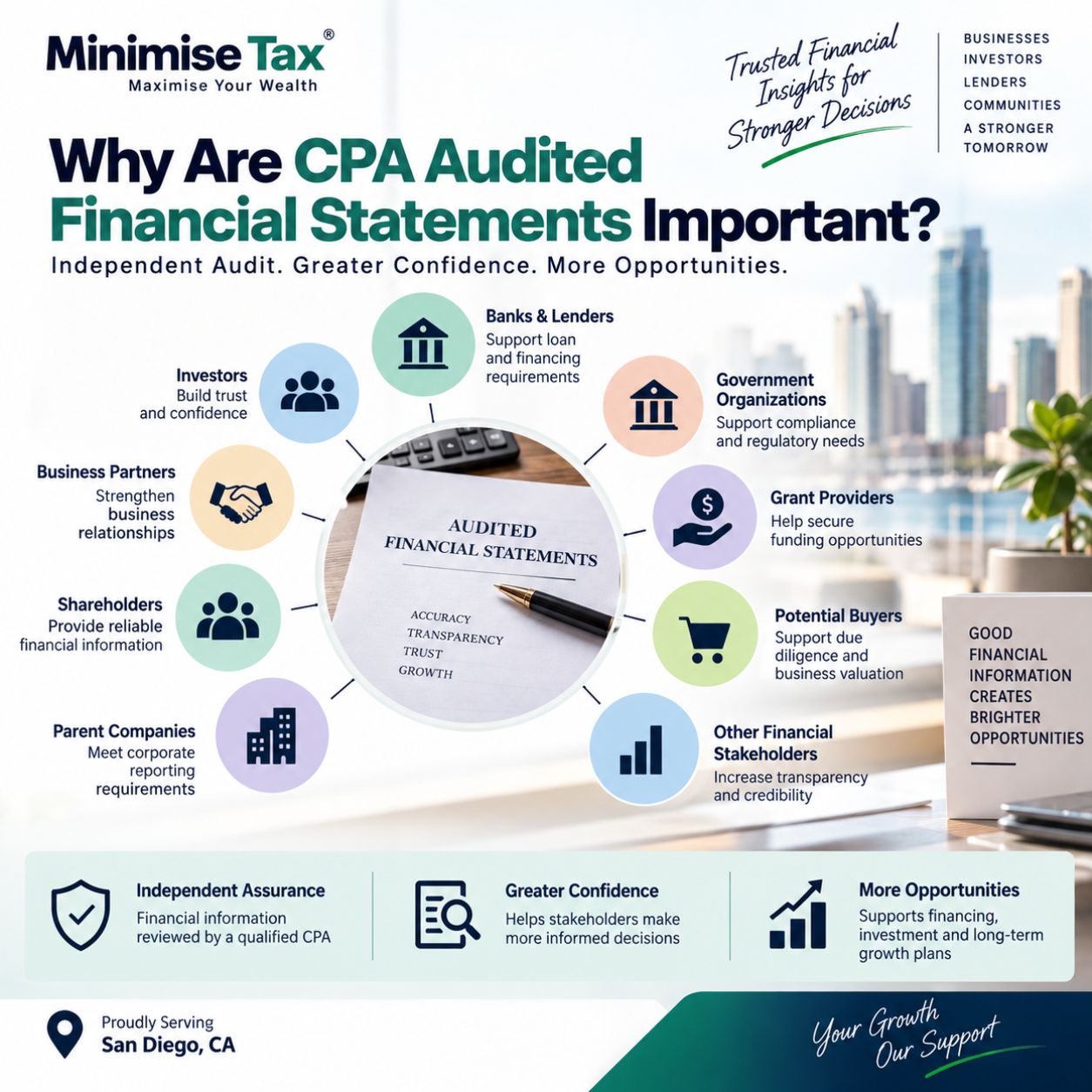
Why Are CPA Audited Financial Statements Important?
Financial statements are used by many different stakeholders. However, the level of assurance required can vary depending on the purpose.
Audited financial statements may provide additional confidence to parties such as:
- Banks and lenders
- Investors
- Business partners
- Shareholders
- Parent companies
- Government organizations
- Grant providers
- Potential buyers
- Other financial stakeholders
For example, a lender evaluating a business loan may want more than internally prepared financial statements. An independent audit can provide additional assurance that the financial information has been subjected to audit procedures.
An audit does not guarantee that a business is financially successful or that a lender will approve financing. Instead, it provides an independent opinion on the financial statements based on the applicable auditing standards.
When Does a San Diego Business Need an Audit?
Not every business requires an audit. The need generally depends on the company’s circumstances and the requirements associated with the intended use of its financial statements.
A San Diego business may need audited financial statements when:
- A lender specifically requires them
- An investor requests audited financial information
- A contract requires an audit
- A parent company requires audited reporting
- A regulatory requirement applies
- A business transaction requires additional financial assurance
- A potential buyer requests audited records
- A funding organization requires audited financial statements
- Business owners want independently audited financial reporting
The exact requirements should always be confirmed with the organization requesting the financial statements.
CPA Audited Financial Statements for Business Loans
Business financing is one of the common situations in which financial statements may be requested.
When applying for a significant business loan, a lender may evaluate the company’s revenue, profitability, assets, liabilities, cash flow, and overall financial position.
Depending on the loan and lender requirements, the business may be asked to provide financial statements for previous years along with current financial information.
If audited statements are specifically required, the business should not assume that a compilation or review will meet the lender’s requirements.
Before beginning an engagement, ask the lender:
- What periods are required?
- Are audited statements mandatory?
- Is a review acceptable?
- Which accounting framework should be used?
- Are specific financial statement formats required?
- Is an auditor’s report required?
- Is there a submission deadline?
Getting these details early can prevent unnecessary delays.
CPA Audited Financial Statements for Investors
Investors often need reliable financial information before committing capital to a business.
Audited financial statements can help investors understand reported financial performance and financial position while providing an independent CPA opinion on the financial statements.
Investors may examine information such as:
- Revenue growth
- Operating expenses
- Net income
- Assets
- Liabilities
- Cash flow
- Debt
- Equity
- Financial trends
Audited statements can therefore become an important part of financial due diligence.
However, investors generally consider many factors beyond financial statements, including the company’s industry, management, market conditions, business model, competition, and future prospects.
What Does a CPA Audit Include?
The exact procedures performed during an audit depend on the company’s circumstances, accounting system, financial reporting framework, and identified risks.
Audit work may involve examining or testing information related to:
- Revenue transactions
- Expense transactions
- Cash balances
- Bank reconciliations
- Accounts receivable
- Accounts payable
- Inventory
- Fixed assets
- Loans
- Liabilities
- Payroll
- Equity
- Related party transactions
- Financial statement disclosures
The CPA determines appropriate audit procedures based on professional judgment and applicable standards.
An audit does not necessarily involve checking every transaction individually. Auditors use procedures designed to obtain sufficient appropriate audit evidence to support their opinion.
CPA audited financial statements in San Diego, CA can be an important financial resource when a business needs independently audited financial information for lenders, investors, partners, regulators, or other stakeholders.
What Financial Statements Are Audited?
A typical set of financial statements may contain several important components.
1. Balance Sheet
The balance sheet presents the company’s assets, liabilities, and equity at a specific date.
It can help users understand what the company owns, what it owes, and the resulting equity position.
2. Income Statement
The income statement presents revenues and expenses over a defined period and shows the resulting profit or loss.
3. Statement of Cash Flows
The statement of cash flows explains how cash moved through operating, investing, and financing activities.
Cash flow information can be particularly important when evaluating a company’s ability to meet financial obligations.
4. Statement of Changes in Equity
This statement presents changes in the company’s equity during the reporting period when applicable.
5. Notes to Financial Statements
The notes provide additional information that helps users understand the accounting policies, balances, transactions, commitments, and other relevant disclosures.
6. Independent Auditor’s Report
The auditor’s report communicates the CPA’s opinion on the financial statements based on the audit performed.

How Long Do CPA Audited Financial Statements Take?
The timeline varies from one company to another.
Factors that can affect the audit timeline include:
- Business size
- Number of transactions
- Accounting system
- Quality of bookkeeping
- Number of locations
- Industry complexity
- Inventory requirements
- Financial reporting requirements
- Availability of supporting records
- Management responsiveness
- Previous audit history
A company with organized records may be easier to audit than a business that needs significant bookkeeping cleanup before the engagement.
If you have a financing, investment, transaction, or regulatory deadline, communicate that deadline to the CPA as early as possible.
How Can a San Diego Business Prepare for an Audit?
Preparation can make a significant difference in the audit process.
Before the engagement begins, consider:
- Reconciling bank accounts
- Reviewing accounts receivable
- Reviewing accounts payable
- Updating inventory records
- Organizing contracts
- Maintaining supporting documentation
- Reviewing fixed asset schedules
- Reconciling loans and liabilities
- Organizing payroll records
- Preparing requested financial schedules
- Resolving outstanding accounting issues
Businesses should also make sure that financial records are current and that supporting documents can be provided when requested.
Documents Needed for CPA Audited Financial Statements
Good recordkeeping can make the audit process more efficient.
Depending on the business, the CPA may request:
- General ledger
- Trial balance
- Bank statements
- Bank reconciliations
- Accounts receivable aging
- Accounts payable aging
- Inventory reports
- Payroll records
- Fixed asset schedules
- Loan documentation
- Contracts
- Tax returns
- Revenue records
- Expense documentation
- Equity records
- Prior year financial statements
- Supporting schedules
Additional documentation may be required depending on the company’s industry and financial structure.
Providing complete records promptly can help the CPA perform the necessary audit procedures efficiently.
Frequently Asked Questions About CPA Audited Financial Statements
CPA Audited Financial Statements are financial statements examined through an independent audit performed by a CPA. The engagement results in an auditor's report expressing an opinion on the financial statements.
No. Many businesses do not require an audit. The need depends on financing arrangements, contracts, investors, regulations, business transactions, and other circumstances.
Some lenders require them for particular loans or borrowers, while others may accept reviewed or compiled financial statements. Always ask your lender for its specific requirements.
An audit provides reasonable assurance and an auditor's opinion. A compilation does not provide assurance and is primarily focused on presenting financial information in financial statement form.
They can be useful because they provide financial information accompanied by an independent auditor's opinion. Investors may use them as one part of their overall due diligence.
They may support the financial due diligence process by providing independently audited financial information. Buyers may still conduct additional due diligence before completing a transaction.
Yes. A small business can engage a CPA for an audit when an audit is appropriate and the engagement is accepted under applicable professional requirements.
Records may include accounting ledgers, bank statements, reconciliations, invoices, contracts, payroll records, inventory documentation, loan information, tax returns, and other supporting schedules.
No. An audit provides an opinion on the financial statements. A lender makes its own financing decision based on its underwriting standards and other information.
The appropriate frequency depends on the reason for the audit and the requirements of the relevant stakeholders. Some organizations may require annual audits.
Maintain accurate accounting records, reconcile accounts regularly, organize supporting documents, prepare requested schedules, and respond promptly to CPA requests.
Minimise Tax provides accounting and CPA-related financial services for businesses and individuals. Contact the firm to discuss your specific financial statement requirements and determine the appropriate service.
Get Professional CPA Audited Financial Statement Support
Conclusion
CPA Audited Financial Statements in San Diego, CA can provide important independent assurance when businesses need financial information for lenders, investors, business transactions, contracts, or other professional purposes.
An audit is different from a review or compilation, so it is important to identify the exact level of financial assurance required before starting an engagement. Businesses should also prepare accurate accounting records and communicate deadlines early.
If your San Diego business needs audited financial statements or professional accounting assistance, Minimise Tax can help you understand the documentation and financial service requirements relevant to your situation.